
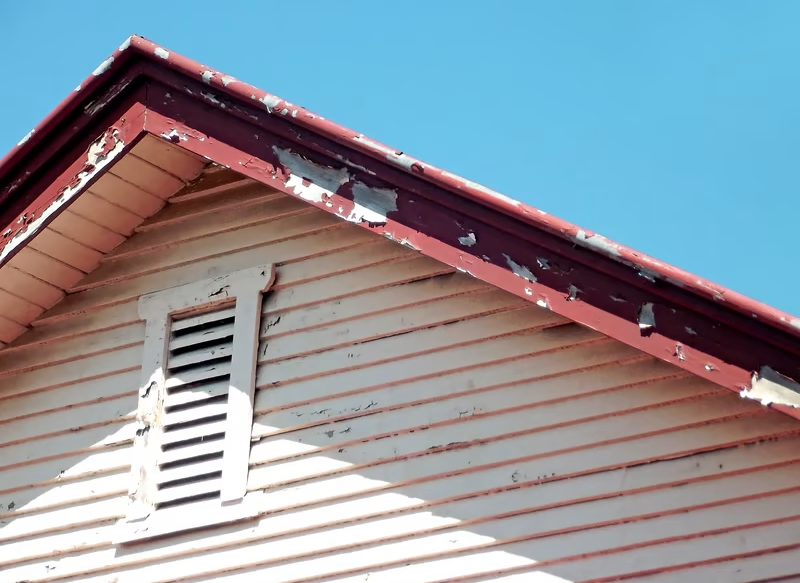
Wood rot in Louisiana’s soffit and fascia boards develops faster than in almost any other state because south Louisiana maintains humidity above 80 percent for roughly half the year, creating ideal conditions for fungal growth. Left untreated, rotted fascia pulls gutters away from the roofline and allows water to track directly into the attic and wall cavities. Big Easy Roofers inspects soffit and fascia condition on every roof job across the New Orleans metro and Northshore.
If you own a home in Mandeville, you already know that the Northshore’s relentless humidity takes a toll on everything from driveways to decks. What most homeowners overlook, though, is the damage happening right at their roofline. Wood rot in soffit and fascia boards is one of the most common and most costly problems facing Louisiana homeowners, and it often goes unnoticed until a full roof repair becomes unavoidable. At Big Easy Roofers, we see it on nearly every Northshore inspection we perform, and the pattern is almost always the same: moisture gets in, rot spreads quietly, and the damage compounds before anyone looks up.
Louisiana’s average relative humidity hovers between 70% and 80% year-round. That number matters because wood decay fungi become active once wood moisture content reaches approximately 20%, which corresponds to sustained ambient humidity above 80%. In south Louisiana, those conditions are not occasional, they are the baseline for roughly half the year.

Here is how the cycle works. Wood soffit and fascia boards absorb moisture from humid air, morning dew, and rain splash. In a drier climate, those boards would dry out between weather events. In Louisiana, the air itself holds so much moisture that the wood rarely gets a chance to fully dry. Over months, this repeated saturation breaks down the wood fibers from the inside. The surface may still look intact while the interior has already turned soft and spongy.
This process is especially aggressive on the north-facing sides of homes, under deep eave overhangs, and anywhere shade prevents direct sunlight from accelerating evaporation. Scheduling a professional schedule a wood rot and roof inspection is the most reliable way to catch decay before it spreads into structural framing.
Mandeville sits on the north shore of Lake Pontchartrain in St. Tammany Parish, and that geography creates a unique combination of moisture challenges. The lake generates persistent humidity and salt-tinged air that reaches homes throughout the area, particularly those closer to the waterfront along Lakeshore Drive and the Old Mandeville neighborhoods.
Beyond the lake, Mandeville is known for its lush canopy of live oaks, magnolias, cypress, and pines. That tree cover is part of the town’s character, but it also means extensive shade over rooflines. Shaded areas beneath Mandeville’s oak canopy stay damp longer, creating ideal conditions for mold, mildew, and wood rot. Leaves, pine needles, and other debris accumulate in gutters faster under heavy tree canopy, leading to water overflow that saturates fascia boards season after season.
St. Tammany Parish also receives approximately 64 inches of rainfall annually, well above the national average of around 38 inches. Combined with tropical storm activity and the Northshore’s subtropical conditions, Mandeville homes face more moisture exposure than most places in the country.


 By Admin
 0 Comment
 Jul 7, 2026