Hurricane Season Roof Prep Checklist 2026 | Big Easy Roofers
FREE Roofing Estimates
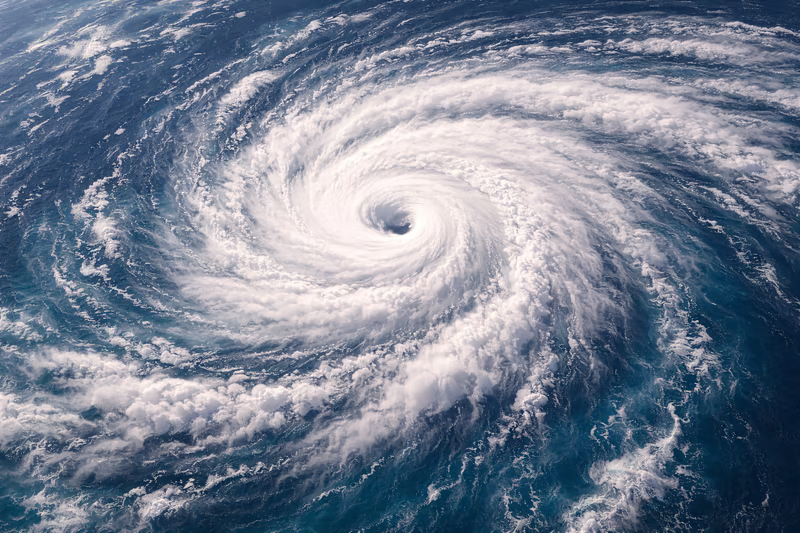
Hurricane path map gulf coast louisiana weather

2026 Hurricane Season Roof Prep: A Checklist for New Orleans Homeowners

The 2026 Atlantic hurricane season begins June 1, and New Orleans homeowners should complete roof inspections, repair loose or missing shingles, clean gutters, and document their roof’s condition for insurance purposes before the first named storm forms. Colorado State University’s April 2026 forecast calls for 13 named storms and 6 hurricanes, with the northern Gulf Coast identified as a primary landfall risk zone. Big Easy Roofers is scheduling pre-season inspections now across the New Orleans metro, and availability fills quickly once tropical activity begins.

Every hurricane season reminds New Orleans homeowners of a hard truth: this city sits in one of the most storm-vulnerable locations in the United States. From Katrina in 2005 to Ida in 2021 and Francine in 2024, the Gulf Coast has absorbed devastating blows that left billions in property damage and hundreds of thousands without power. At Big Easy Roofers, we work with homeowners across southeast Louisiana communities like New Orleans who understand that preparation is the difference between a roof that holds and one that fails. The 2026 Atlantic hurricane season officially begins June 1, and the time to act on your roof is right now, not when the first tropical depression forms in the Gulf.

What Forecasters Are Saying About the 2026 Season

Colorado State University released its April 2026 outlook calling for 13 named storms, 6 hurricanes, and 2 major hurricanes (Category 3 or higher). CSU characterizes this as a “somewhat below-average” season, largely because a developing El Nino pattern is expected to increase wind shear across the tropical Atlantic. AccuWeather’s forecast is slightly wider, projecting 11 to 16 named storms, 4 to 7 hurricanes, and 2 to 4 major hurricanes, with 3 to 5 direct U.S. impacts. NOAA will release its official outlook in late May.

Homeowner clearing gutters before hurricane season

The phrase “below average” can be misleading. AccuWeather’s landfall risk analysis specifically identifies the northern and northeastern Gulf Coast as the zone most likely to take a direct tropical impact in 2026. That corridor stretches from the southeastern Louisiana coast through coastal Mississippi, Alabama, and into the Florida Panhandle. New Orleans sits squarely in this high-risk zone, a city built largely below sea level in Orleans Parish, protected by an extensive federal levee system that was overhauled after Katrina but still tested by every major storm. Forecasters also warn that warm sea-surface temperatures deep below the Gulf’s surface could fuel rapid intensification, where a tropical storm strengthens into a major hurricane within 24 hours. Hurricane Ida did exactly that in 2021, jumping from Category 1 to Category 4 in less than a day before slamming into Port Fourchon.

Why New Orleans Faces Elevated Risk Every Year

New Orleans occupies a uniquely exposed position within the Mississippi River delta, surrounded by water on nearly every side. Much of the city sits below sea level, with neighborhoods like Lakeview, Gentilly, and the Lower Ninth Ward depending entirely on the federal levee and floodwall system to hold back Lake Pontchartrain, the Mississippi River, and the Gulf Intracoastal Waterway. When hurricanes push storm surge northward through Lake Borgne and into Lake Pontchartrain, the entire metro area faces rising water pressure against those barriers. During Hurricane Katrina, catastrophic levee failures flooded roughly 80% of the city and destroyed thousands of roofs across Orleans Parish. Ida knocked out power across the entire metro for over a week and peeled roofs off homes throughout Gentilly, Mid-City, and eastern New Orleans. Hurricane Francine, a Category 2 storm that made landfall in Terrebonne Parish in September 2024, dumped heavy rainfall across the metro area, triggered flash flood emergencies, caused roughly $1.3 billion in total losses across the region, and left around 450,000 people without electricity.

The lesson from every one of these storms is the same: the roof is the first line of defense. When roofing materials fail, water intrusion damages insulation, drywall, electrical systems, and personal property within hours. A compromised roof also reduces the structural integrity of the entire home, making walls and windows more susceptible to wind pressure.

Your 10-Step Hurricane Roof Prep Checklist

Complete these steps before the end of May to give yourself time for repairs if your inspection uncovers problems.

Roofer sealing roof ridge before storm season

  1. Schedule a professional roof inspection. A licensed contractor can identify vulnerabilities invisible from the ground, including weakened decking, deteriorating underlayment, and improper fastener patterns. Spring is the ideal window for this, and schedule your pre-season roof maintenance catches small issues before they become storm-season emergencies. Big Easy Roofers is currently accepting spring inspection bookings across Orleans and Jefferson Parish.
  2. Check shingles for damage. Walk the perimeter of your home and use binoculars to look for missing, cracked, curled, or lifted shingles. Even one missing shingle creates an entry point for wind-driven rain, and loose shingles can become dangerous projectiles in hurricane-force gusts.
  3. Inspect flashing around penetrations. The metal strips around chimneys, vents, skylights, and dormers are among the most common failure points during storms. Look for rust, gaps in sealant, or flashing that has pulled away from the surface. Resealing or replacing flashing is a cost-effective repair that prevents major water intrusion.
  4. Clean gutters and downspouts. Clogged gutters cause water to back up under the roof edge during heavy rainfall, saturating fascia boards and soffit materials and allowing moisture behind the drip edge. Clear all debris, check that downspouts direct water at least four feet from the foundation, and confirm that gutter hangers are secure.
  5. Trim trees and remove dead branches. Overhanging limbs are the leading source of puncture damage during hurricanes. Cut back any branches that hang within six feet of the roof, and remove dead or dying trees entirely. The live oak canopy that defines so many New Orleans neighborhoods creates significant risk when heavy branches snap under sustained winds, especially in older areas like Lakeview, Gentilly, and along the Bayou St. John corridor.
  6. Inspect the attic from inside. Look for water stains, discoloration, daylight coming through the decking, and signs of mold. Check that hurricane straps or clips connecting the rafters to the wall framing are present and secure. Louisiana building codes require these connectors, and their absence is a critical vulnerability.
  7. Verify soffit and ridge vent integrity. Soffit panels that are loose or missing allow wind-driven rain to pressurize the attic space, which can lift the roof deck from underneath. Make sure all ventilation openings are intact and that baffles are in place to manage airflow without admitting water.
  8. Seal gaps around skylights and roof-mounted equipment. HVAC units, satellite dishes, and solar panel mounts all create penetration points. Confirm that each mount is secured to the structure (not just the decking) and that surrounding sealant is intact.
  9. Assess your weatherproofing layer. The underlayment beneath your shingles or metal panels is the secondary barrier against water intrusion. If your roof is more than 15 years old, the underlayment may have degraded. Talk to your contractor about whether a book a weatherproofing assessment now is warranted, especially if you have never had the underlayment evaluated.
  10. Document everything for your insurance file. Photograph your roof from multiple angles, keep copies of inspection reports, and store digital backups of your homeowner’s policy, declarations page, and any previous claim records. After a storm, having a documented pre-storm condition makes the claims process significantly faster.

FORTIFIED Roofing and Louisiana Grants for 2026

Louisiana is pushing hard toward stronger residential roofing standards. The IBHS FORTIFIED Roof designation certifies that a roof can withstand wind speeds up to 130 mph. As of early 2026, Louisiana insurers are required to provide premium discounts for homes with a FORTIFIED designation. South Louisiana homeowners with a base-level FORTIFIED roof receive a 29% discount on the hurricane portion of their premium, while gold-level designations in south Louisiana qualify for discounts up to 49%.

The Louisiana Fortify Homes Program offers grants of up to $10,000 to help homeowners upgrade their roofs to FORTIFIED standards. The program uses a random lottery system due to high demand, and as of 2025 legislative changes, the grant money is exempt from state income tax. New funding streams, including $5 million from surplus lines tax collections, take effect July 1, 2026. If you are a New Orleans homeowner considering a roof upgrade, applying for this program before hurricane season is a smart financial move. Big Easy Roofers is familiar with the FORTIFIED certification process and can walk you through the requirements during an inspection.

Pending legislation (SB 147) would require all new residential roofs and full roof replacements to meet or exceed FORTIFIED standards statewide. Even if the bill does not pass this session, the direction is clear: FORTIFIED is becoming the baseline expectation in Louisiana.

What to Do If a Storm Hits Before You Finish Prepping

If a tropical system enters the Gulf before you have completed your checklist, focus on what you can control in the remaining hours. Move vehicles into covered areas. Clear your yard of any loose objects that could become airborne. If you have tarps and plywood, pre-position them where you can access them quickly after the storm passes. Do not attempt to get on your roof once winds exceed 20 mph.

After the storm, resist the urge to climb onto a damaged roof yourself. Wet surfaces, hidden structural damage, and downed power lines create serious hazards. Contact a licensed contractor who provides get emergency roofing help after a storm to perform a safe assessment and install temporary protective measures while permanent repairs are scheduled. Big Easy Roofers offers same-day emergency response across the greater New Orleans area after storm events.

If a storm does damage your roof despite preparation, learn about see emergency tarping options for your area.

Frequently Asked Questions

When should I have my roof inspected before hurricane season?

Schedule your inspection in April or May so there is time to complete any repairs before the June 1 start of the Atlantic hurricane season. Waiting until a storm is in the forecast means contractors are already overwhelmed with emergency calls, and material availability tightens quickly across the New Orleans metro area.

How do I know if my roof can handle hurricane-force winds?

A professional inspection evaluates your decking attachment, fastener pattern, shingle or panel condition, flashing integrity, and whether hurricane straps connect the roof structure to the walls. Homes built before 2005 often lack the connectors and attachment methods required by current Louisiana building codes. If your home was built or re-roofed before that year, an evaluation is especially important.

What is a FORTIFIED roof and does it qualify for an insurance discount in Louisiana?

A FORTIFIED designation from the Insurance Institute for Business and Home Safety means a roof has been built or retrofitted to resist wind speeds up to 130 mph using reinforced decking, sealed joints, and upgraded connectors. Louisiana now requires insurers to offer hurricane premium discounts ranging from 16% to 49% depending on your region and designation level.

Does homeowner’s insurance cover storm damage to an older roof?

Most policies cover sudden wind and water damage regardless of roof age, but insurers may depreciate the payout on older roofing materials. Some carriers in Louisiana have also begun requiring proof of recent inspection or FORTIFIED upgrades before issuing or renewing policies in high-risk parishes like Orleans. Review your declarations page and contact your agent before the season starts to understand your specific coverage.

What is the biggest mistake homeowners make when preparing their roof for hurricane season?

The most common error is assuming a roof that looks fine from the ground is actually storm-ready. Many critical vulnerabilities, such as degraded underlayment, improperly sealed flashing, or missing hurricane straps in the attic, are invisible without a hands-on inspection. The second most common mistake is waiting too long. Once a named storm enters the Gulf, every qualified contractor in the region is booked solid within hours.